
 ALL Products
 Expert Advisors
 MT4 Expert Advisors
 MT5 Expert Advisors
 Indicators
 Browse by Strategies
 Home
Home About us
 Contact us
 Blog
Blog Risk Disclaimer
-98%

MultiWay EA MT5 v1.11 with Original SetFiles
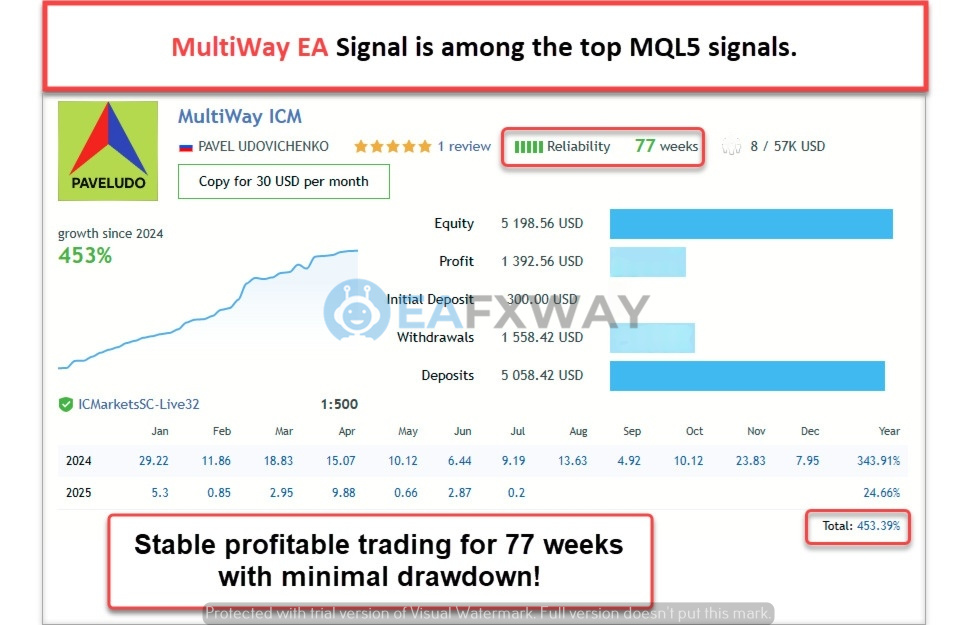
MultiWay EA generates 371% over 77 weeks via 9-pair mean-reversion grid – live-verified on ICMarkets real account with controlled-loss exit across correlated FX pairs
Original price was: $1,984.00.$39.99Current price is: $39.99.

✓
Verified Original & Safe
✓
Instant Download After Purchase
✓
Free Updates for Future Versions
✓
Free Dedicated Remote Support
✓
Unlimited Activations on Your Accounts
✓
Money-Back Guarantee (Details)
Reviewed by Jason Chen
Risk warning: Trading involves risk. Read full disclaimer
Secure Checkout

Table of Contents
MultiWay EA — 9-Pair Mean-Reversion Portfolio with Controlled-Loss Exit
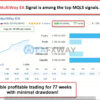
MultiWay EA trades 9 correlated FX pairs simultaneously using mean-reversion logic — a portfolio approach that live signal data shows reached 371% growth over 77 weeks with a profit factor of 1.15. The MQL5 signal account (ICMarkets SC-Live32, 1:500 leverage) recorded 982 trades with a peak equity drawdown of 57.54%. Developer is Pavel Udovichenko, with an active changelog and public signal link.
➡️ Vendor website: View here
Key Benefits
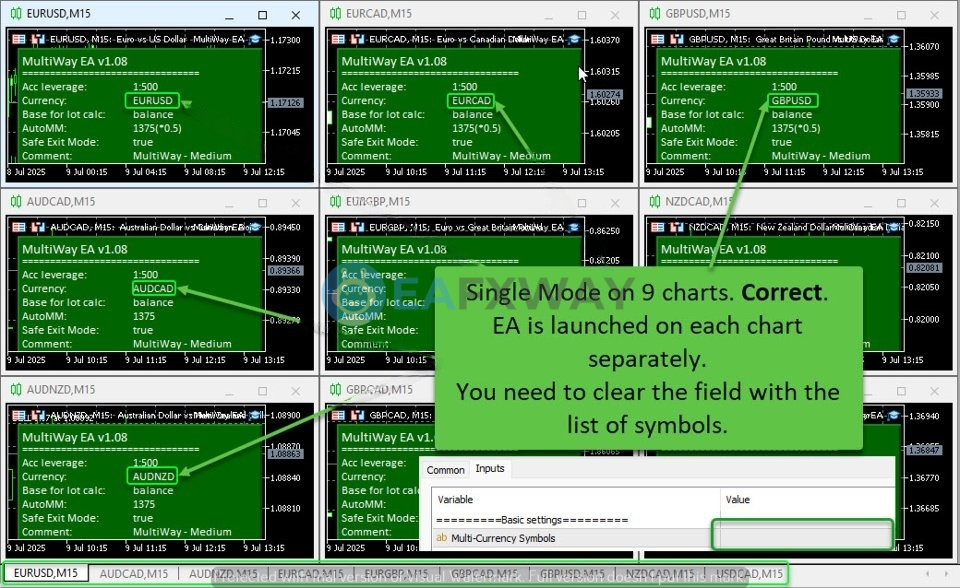
- ✅ 9-Pair Portfolio Core: Trades AUDNZD, NZDCAD, AUDCAD, USDCAD, EURUSD, GBPUSD, EURCAD, EURGBP, GBPCAD simultaneously — single-pair concentration risk is structurally reduced. Explore MT4 alternatives
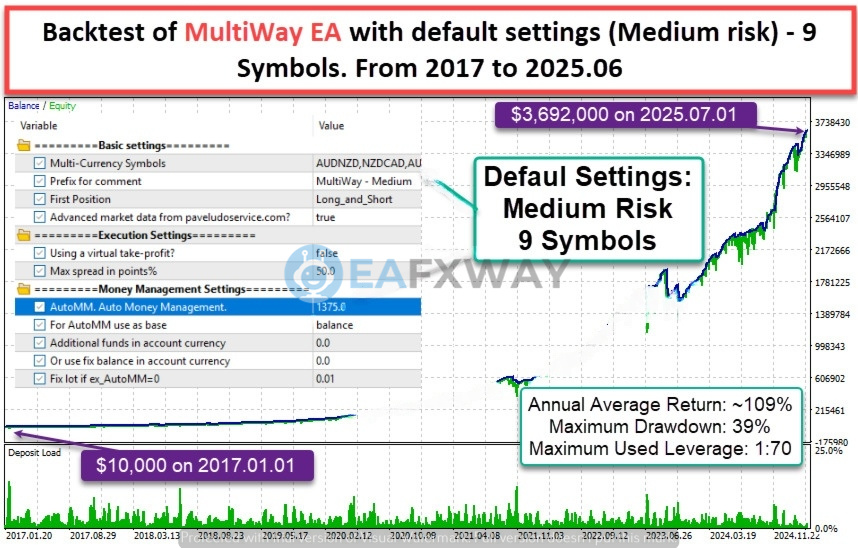
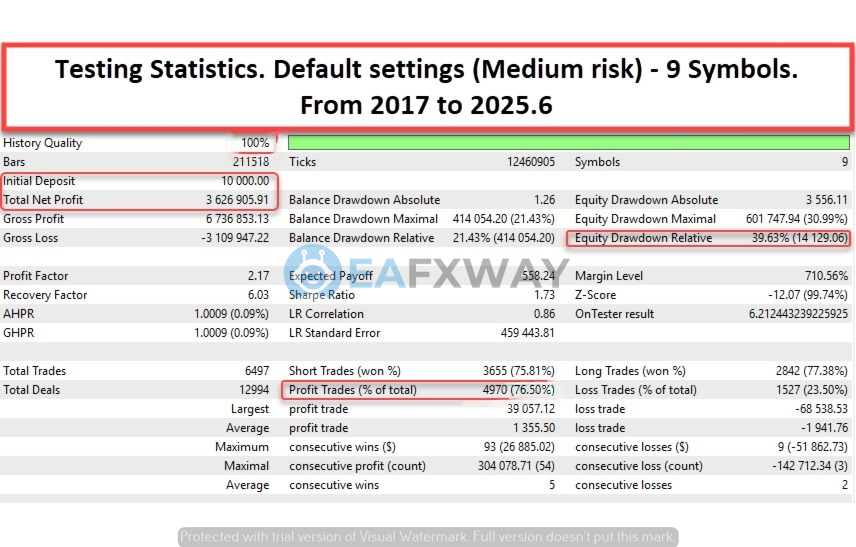
- ✅ Controlled-Loss Exit: Closes unfavorable positions at a defined loss rather than holding indefinitely — backtest over 2017–2025 shows this kept balance drawdown at 21.43% while equity DD peaked at 39.63%.
- ✅ Grid Without Martingale: Grid recovery used across pairs; lot sizes do not double on losses — exposure compounds by position count, not by exponential lot scaling. Compare EA strategies
- ✅ Volatility Filter: Advanced filters block entries during one-way trending phases; rollover TP removal (23:45–01:05) reduces anomalous fills during low-liquidity windows.
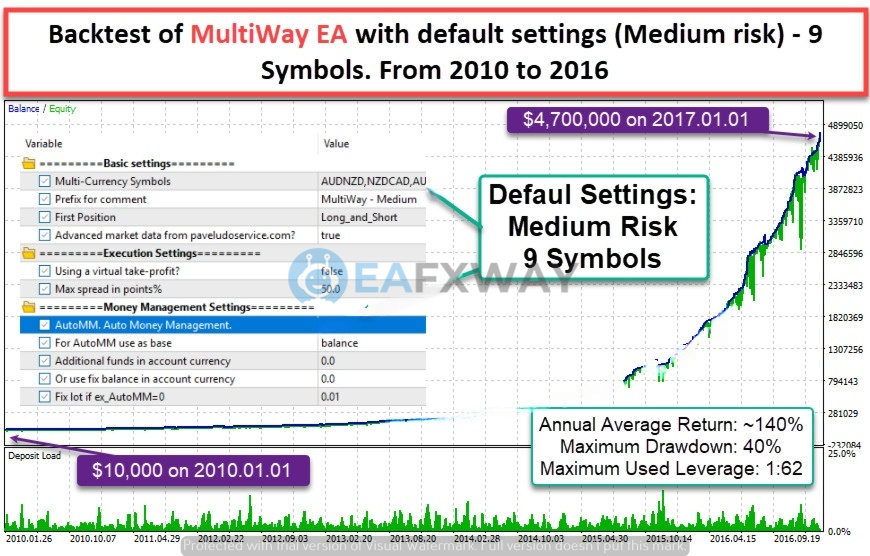
- ✅ 15-Year Backtest Span: Two separate backtest windows (2010–2016 and 2017–2025) at 100% history quality across all 9 symbols — combined 6,497 trades with a profit factor of 2.17.
>>>> Join the Telegram community for free discussions.
MultiWay EA Performance
The MQL5 live signal (ICMarkets SC-Live32, real account) grew 371.10% across 77 weeks from a $300 initial deposit, recording 982 trades with a profit factor of 1.15. A separate Myfxbook real account shows +356.26% gain and a profit factor of 1.15 — note that account displays MT4 platform, while this product runs on MT5; treat it as corroborating context rather than version-matched proof.
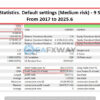
The 2017–2025 backtest (100% history quality, 9 symbols, $10,000 start) produced a total net profit of $3,626,905 across 6,497 trades. Profit factor reached 2.17; Sharpe ratio 1.73; win rate 76.50%. The 2010–2016 window added further validation: ~140% average annual return, 40% maximum drawdown, on the same 9-pair configuration.
The core risk: MultiWay breaks hardest when multiple pairs enter a sustained one-way trend simultaneously — USD strength or weakness that crosses EURUSD, GBPUSD, USDCAD, and AUDCAD at the same time opens correlated grid positions across four pairs at once, compounding exposure rather than diversifying it. This is a structural weakness — it cannot be removed, only sized for. The live signal shows a peak equity drawdown of 57.54% under real conditions. The controlled-loss exit mechanism prevents endless holding, and the volatility filter blocks new entries during strong trends, but neither eliminates drawdown during coordinated multi-pair moves. At the documented medium-risk AutoMM setting (1.37% of balance), backtest equity DD reached 39.63% — reducing AutoMM to a more conservative level lowers exposure but also reduces return proportionally; exact conservative-preset outcomes are not published and require demo testing to classify.
Live results verified on MQL5 signal (ICMarkets SC-Live32). Past data does not predict future returns.
How It Works
- Mechanism: Mean-reversion across 9 correlated FX pairs — EA identifies impulse moves away from the average, then enters counter-trend positions expecting a pullback. Grid layers add if price continues against the initial entry; the volatility filter suppresses new entries when trending behavior is detected. This approach generates income during range-bound, oscillating conditions across the pair basket.
- Signal Trigger: Impulse detection on each pair triggers entry; advanced market data from paveluodservice.com is required (enabled by default). Max spread threshold: 50 points.
- Position Close: Profit target closes winners; the controlled-loss exit closes losing grids when continuation is detected — no position held indefinitely. TP orders removed during 23:45–01:05 rollover window to avoid low-liquidity fills.
- Exposure Limits: AutoMM set to 1.37% of balance at medium risk; maximum leverage used in 2017–2025 backtest reached 1.70x — well below the 1:100 minimum leverage requirement. Safe Exit Mode available.
✅ Optimal conditions: Range-bound pairs • Low-spread ECN execution • Stable multi-pair correlation structure
⚠️ Avoid when: Strong sustained USD trend crossing 4+ pairs simultaneously • Spreads exceeding 50 points on any active pair
Recommended Settings
| Specification | Requirement |
|---|---|
| Platform | MetaTrader 5 (MT5) |
| Currency Pairs | AUDNZD, NZDCAD, AUDCAD, USDCAD, EURUSD, GBPUSD, EURCAD, EURGBP, GBPCAD |
| Minimum Deposit | $3,000 |
| Recommended Deposit | $5,000 |
| Leverage | 1:100 minimum; 1:500 used on live signal |
| Broker Type | Low spread ECN; recommended: IC Markets, IC Trading, Valutrades |
| Account Type | Hedging account required |
| VPS | Mandatory — 24/7 uptime required |
Who Should Use This EA
✅ Purchase this EA if you:
- Run MT5 with a hedging-enabled account at IC Markets, IC Trading, or Valutrades
- Have $5,000+ starting capital and can tolerate equity drawdown above 40% during adverse multi-pair moves
- Can run a VPS 24/7 and complete the post-purchase setup (private message to developer required for full instructions)
- Want a portfolio-diversified approach rather than a single-pair strategy
✅ Performance verified with:
- Real account on ICMarkets SC-Live32, 1:500 leverage, hedging, 77 weeks live
- Backtest capital: $10,000 starting deposit across 9-pair medium-risk configuration
Product Download Package Includes
1. Experts:
✅ MultiWay EA.ex5
2. Presets:
✅ MultiWay_High Risk_$1.5K.set
✅ MultiWay_Low Risk_$6K.set
✅ MultiWay_Medium Risk (default)_$3K.set
✅ MultiWay_Non-Сompounding_$10K_Medium Risk.set
Frequently Asked Questions
What results can I realistically expect with MultiWay EA?
How often does MultiWay EA trade, and will it cover its cost quickly?
What is the 'controlled-loss exit' and how does it protect my account?
How does the grid work across 9 pairs — and what is the maximum exposure?
How much capital do I need to get started with MultiWay EA?
What are the main risks and how does MultiWay EA handle them?
Which brokers and account types work best with MultiWay EA?
What support do I get after purchasing?
Only logged in customers who have purchased this product may leave a review.
Content verified and reviewed by Jason Chen
Risk Disclosure:
Forex trading and Expert Advisors carry substantial risk of loss. Past performance does not guarantee future results, and backtest results are not the same as live trading performance. Demo testing is strongly recommended before using live capital.
Read full risk disclaimer
Forex trading and Expert Advisors carry substantial risk of loss. Past performance does not guarantee future results, and backtest results are not the same as live trading performance. Demo testing is strongly recommended before using live capital.
Read full risk disclaimer











Related products
-97%

MT5 Expert Advisors
Original price was: $1,199.00.$39.99Current price is: $39.99.
-96%

MT5 Expert Advisors
Original price was: $899.00.$39.99Current price is: $39.99.
-96%

MT5 Expert Advisors
Sets for Optimal Titan X Performance Titan X 21.48 MT5 with Setfiles
Original price was: $999.00.$39.99Current price is: $39.99.
-93%


MT4 Expert Advisors
Original price was: $599.00.$39.99Current price is: $39.99.
-98%

MT5 Expert Advisors
TFXS Titan Ultimate EA MT5 v10.12 with Original SetFiles (Unlimited)
Original price was: $2,200.00.$39.99Current price is: $39.99.
-96%

MT5 Expert Advisors
Original price was: $899.00.$39.99Current price is: $39.99.
-98%
MT5 Expert Advisors
Original price was: $2,500.00.$39.99Current price is: $39.99.
-98%

MT4 Expert Advisors
Original price was: $2,500.00.$49.99Current price is: $49.99.
Reviews
There are no reviews yet.